Introduction
When discussing PCB layer counts, we typically think of even numbers—2, 4, 6, 8, and so on. However, odd-layer HDI boards do exist, representing about 5% of the HDI market. Even-layer PCBs use a core board (Core), while odd-layer HDI boards adopt a coreless design. Let’s explore the key differences, technical boundaries, and application landscapes of Cored and Coreless HDI.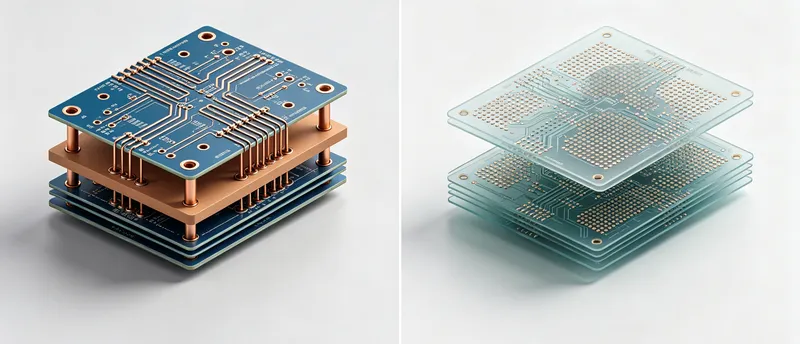
Top 3 Key Differences for Your Design
Stackup Architecture
Coreless HDI: Eliminates the core layer, using Prepreg (PP) or Ajinomoto Build-up Film (ABF) as the base. This enables extremely thin profiles and allows for odd-layer structures (e.g., 3-layer, 5-layer).
Manufacturing Process & Compatibility
Cored HDI: Highly compatible with traditional PCB processes. It relies on mature mechanical/laser drilling and electroplating. Minimal equipment modification means lower investment and risk.
Coreless HDI: Introduces a Detach Core (peelable carrier) to enable thin-board handling during lamination. It builds layers on both sides of the carrier and requires an additional separation process.
Thickness Capability
Cored HDI: Limited by current mainstream equipment, the minimum Core thickness is around 40µm (mass production is usually ≥50µm). This results in a minimum board thickness of ≥170µm for a 4L Any-layer design.
Coreless HDI: Using a Detach Core, a 3L coreless HDI can achieve a total board thickness of just 115µm, offering a distinct advantage in miniaturization.
Data at a Glance
- Market Share: Cored HDI accounts for ~95% of the HDI market (Odd-layer coreless HDI is ~5%).
- Core Thickness Limit: 40µm (Equipment limit) / 50µm (Mass production).
- Minimum Board Thickness: 170µm (4L Cored) vs. 115µm (3L Coreless).
Cored HDI (The Industry Standard): Offers high mechanical strength, excellent anti-bending/impact performance, and low cost. Ideal for smartphones, automotive electronics, and military applications requiring high reliability.
Our Commitment
Cored and coreless HDI are not mutually exclusive. Cored technology is evolving towards thinner dielectrics, while coreless technology is expanding to higher layer counts with added support layers. We continuously push the boundaries of both to meet your specific design requirements.
Ready to optimize your next PCB design?
[Contact our engineering team today] to discuss the best HDI stackup for your project.